
World’s largest 10,000-ton battery-powered bulk cargo ship floats out in Yichang
2025-10-23 22:10:34
By Chen Si.
The 13,700-deadweight-ton Gezhouba has floated out on the Yangtze River in Zigui, marking the launch of the world’s largest fully electric bulk cargo ship and a new chapter in zero-emission freight.
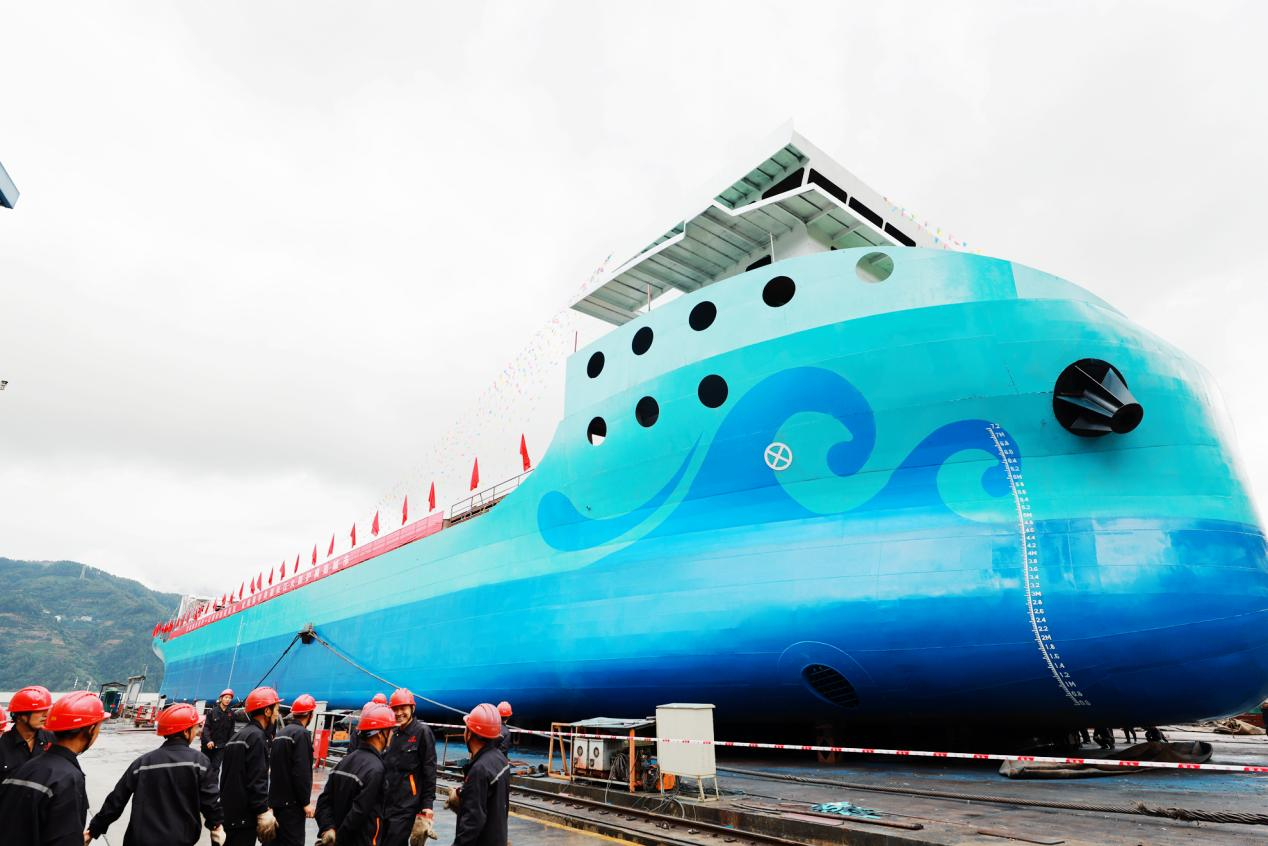
The 13,700-deadweight-ton Gezhouba has floated out on the Yangtze River in Zigui, marking the launch of the world’s largest fully electric bulk cargo ship and a new chapter in zero-emission freight.
Photo by Huang Xiang
Measuring 130 meters long and 22 meters wide, with a designed draft of just 6.5 meters, the steel giant can carry as much cargo as 230 standard rail wagons without burning any diesel along the way.
Powered by 24 MWh of lithium-ion batteries housed in twelve container-sized modules, the ship’s energy system allows cranes to swap batteries within minutes. A single full charge provides a range of about 500 kilometers, enough for a round trip between Shanghai and Nanjing. Operators say the system reduces downtime compared with refueling conventional tugs.
What sets the ship apart is its brain. It is the first large inland carrier certified for remote-control berthing, un-berthing and open-water piloting. An AI navigation suite fuses radar, lidar and high-definition cameras to let a small shore team handle maneuvers that once demanded a dozen sailors, sharply reducing both crew costs and collision risk.
The environmental payoff is immediate. Operators estimate the ship will replace roughly 617 tons of diesel and cut 2,052 tons of CO₂ emissions annually—the equivalent of removing about 1,400 cars from the road. The savings could grow as central China’s power grid increases its share of hydropower.
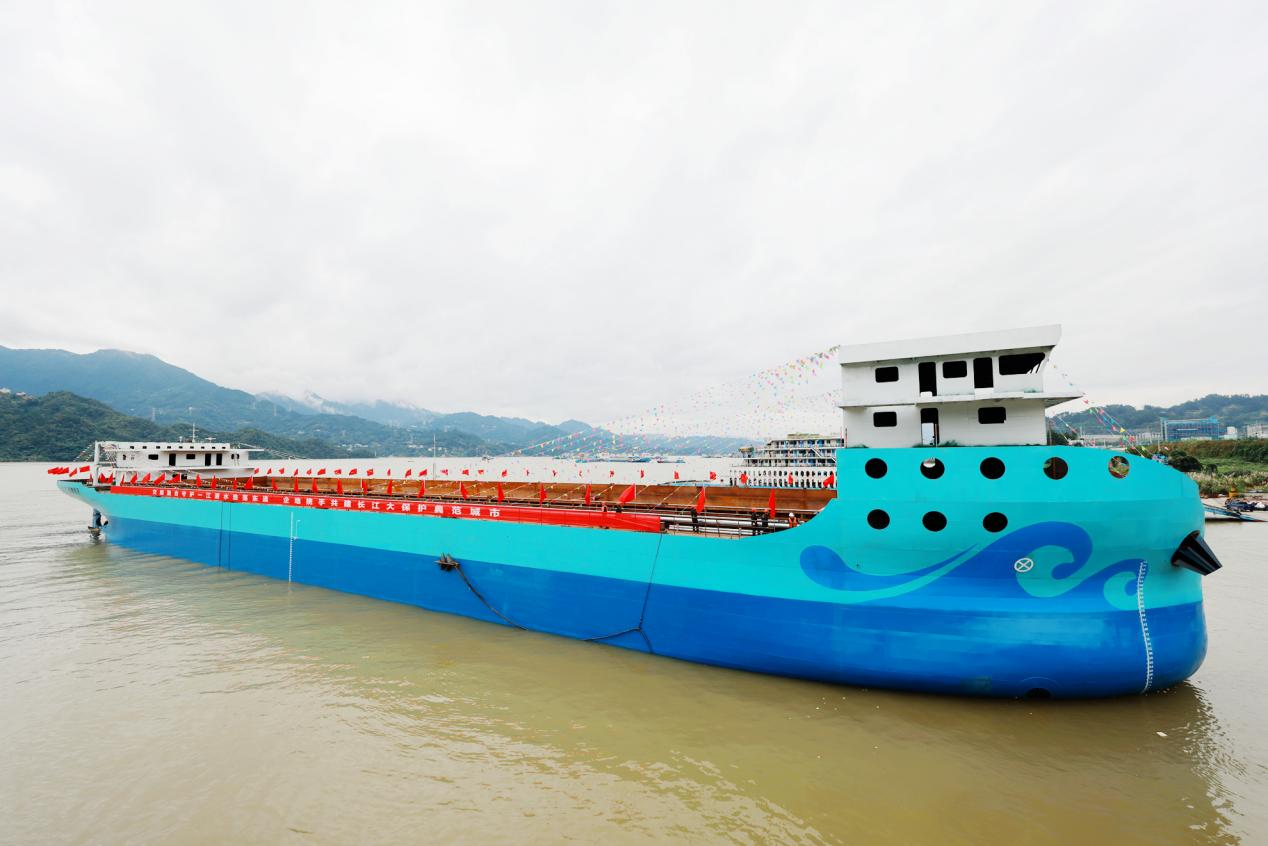 Photo by Huang Xiang
Below deck, safety technology matches the smart bridge. A submerged multi-stage cooling loop keeps battery temperatures within two degrees of target, while a heptafluoropropane fire-suppression network and real-time fault-diagnosis software protect against thermal runaway. Designers say the architecture has already survived nail-penetration and salt-spray tests harsher than anything the Yangtze can deliver.
Engineers view the project as a prototype for large-scale transformation. By combining megawatt-scale marine batteries, a distributed DC power grid, and automated swap stations in one hull, the project demonstrates that the technology chain is ready for fleet-wide adoption. Officials hope the model will help convert the 110,000 diesel-powered bulkers that now operate in the Yangtze basin and offer a blueprint for other river nations to decarbonize inland shipping.
Gao Wei also contributed to this story.