
Acoustic monitors installed to track Chinese sturgeon
2026-03-29 19:03:17
By Hu Yikai.
On March 25, acoustic monitors were installed on six navigation markers along the Yichang section of the Yangtze River to track Chinese sturgeon and build a monitoring network along their migration route.
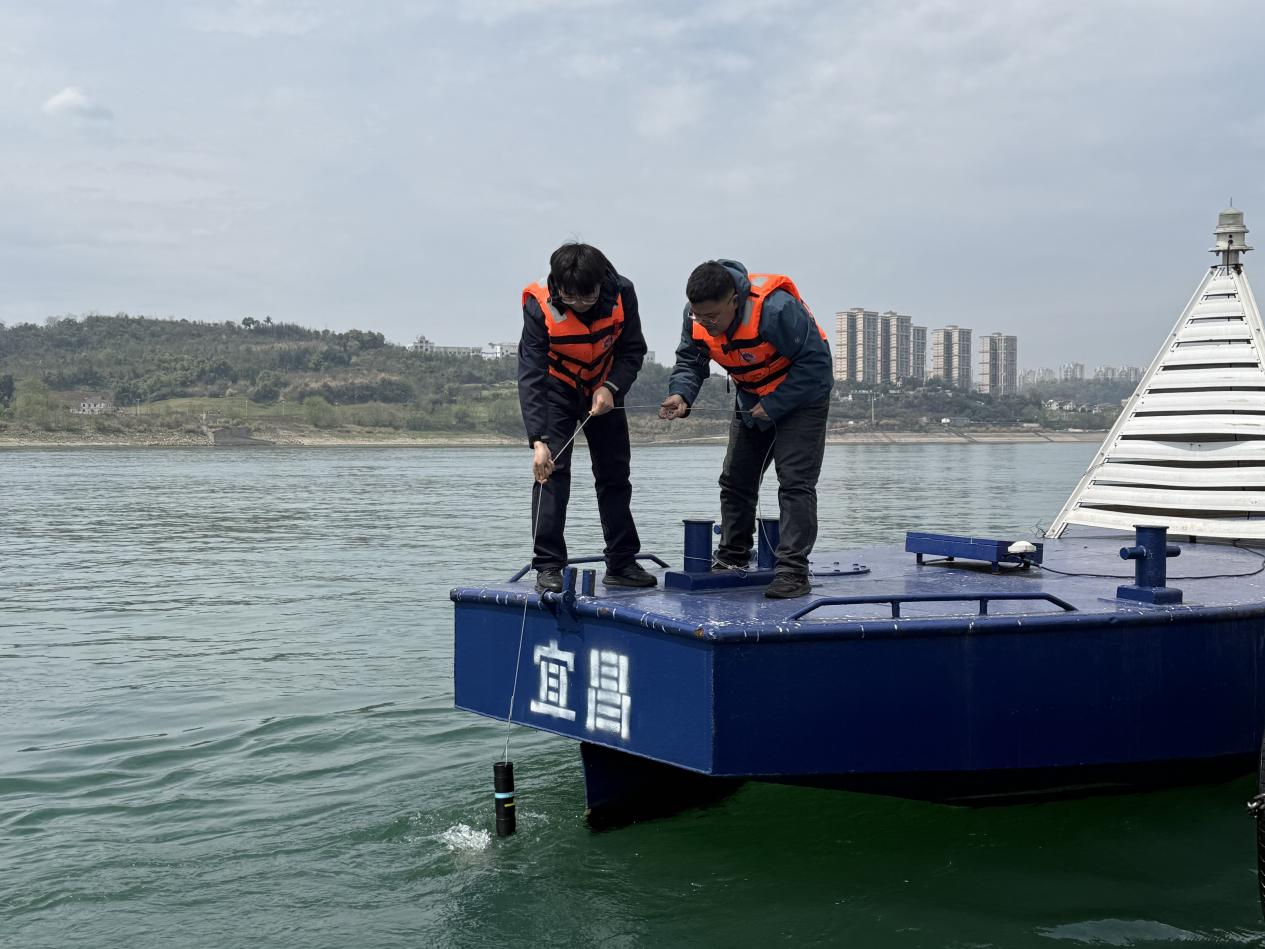
On March 25, acoustic monitors were installed on six navigation markers along the Yichang section of the Yangtze River to track Chinese sturgeon and build a monitoring network along their migration route.
Staff members installing acoustic receivers to track Chinese sturgeon. Photo by Li Meng.
The project was carried out by the Yangtze River Yichang Waterway Bureau in partnership with the Yangtze River Biodiversity Research Center, part of the National Engineering Research Center under China Three Gorges Corporation.
The Chinese sturgeon is one of the oldest vertebrates on Earth, with a history spanning more than 140 million years. In 2010, it was classified as critically endangered by the International Union for Conservation of Nature.
Navigation markers are widely distributed and fixed in the river, making them ideal locations for monitoring equipment, according to researchers at the center. The new system will help determine the species' distribution and better assess the effectiveness of artificial release programs. As of 2024, more than 8 million Chinese sturgeon have been released.
All selected navigation markers are located along the sturgeons’ migration route, covering the river section from below Gezhouba Dam to Aijiahe. The deployment will help track migratory behavior and spatial distribution in the Yichang reach.
Wang Ying and Yang Yi also contributed to this story.
The Chinese sturgeon is one of the oldest vertebrates on Earth, with a history spanning more than 140 million years. In 2010, it was classified as critically endangered by the International Union for Conservation of Nature.
Navigation markers are widely distributed and fixed in the river, making them ideal locations for monitoring equipment, according to researchers at the center. The new system will help determine the species' distribution and better assess the effectiveness of artificial release programs. As of 2024, more than 8 million Chinese sturgeon have been released.
All selected navigation markers are located along the sturgeons’ migration route, covering the river section from below Gezhouba Dam to Aijiahe. The deployment will help track migratory behavior and spatial distribution in the Yichang reach.
Wang Ying and Yang Yi also contributed to this story.