Over 90% of rare Three Gorges plants survive under conservation program
2026-05-23 19:05:58
By Yan Wanqin, Tang Jingyi.
More than 90 percent of rare and endemic plant species from the Three Gorges Reservoir area have survived outside their natural habitats under a conservation program, according to China Three Gorges Corporation.
The program is based at the Yangtze River Rare Plant Breeding Base. To date, more than 32,000 rare plants from over 2,160 species have been relocated and protected.
More than 90 percent of rare and endemic plant species from the Three Gorges Reservoir area have survived outside their natural habitats under a conservation program, according to China Three Gorges Corporation.
The program is based at the Yangtze River Rare Plant Breeding Base. To date, more than 32,000 rare plants from over 2,160 species have been relocated and protected.
 Three Gorges Dam. Photo by Liu Kun.
The Three Gorges Reservoir area serves as a key ecological barrier in the upper reaches of the Yangtze River. A full-chain technical system has been established in the region, covering field surveys, rescue collection, off-site conservation, reintroduction to the wild, ecological restoration, monitoring, and evaluation.
More than 60,000 plants from over 30 rare species, including Myricaria laxiflora, Plantago fengdouensis, Davidia involucrata, and Taxus chinensis, have been reintroduced into the wild. In the Three Gorges Dam area, 12.8 square kilometers of land has undergone ecological restoration, with a vegetation recovery rate of 83.7 percent. The stability of the ecosystem and biodiversity in the reservoir area have been enhanced.
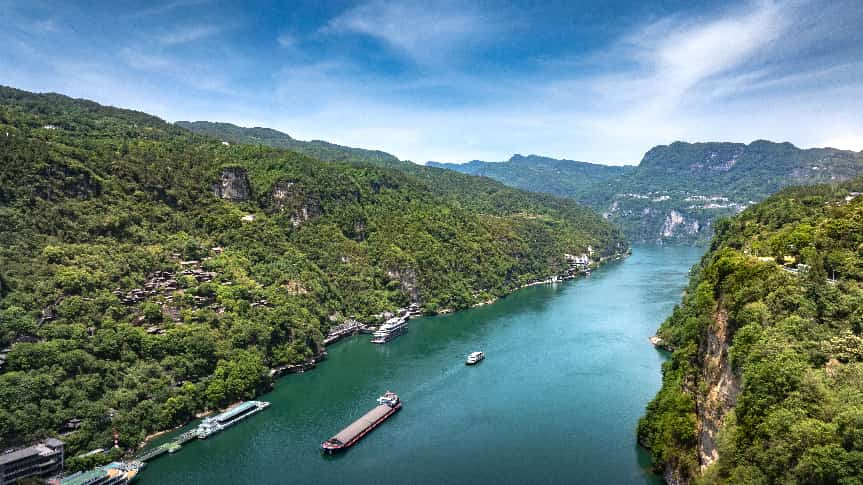 Xiling Gorge. Photo by Liu Kun.
The construction of the Three Gorges Dam project created a vast water-level fluctuation zone with complex drawdown areas, posing challenges to biodiversity conservation.
Researchers have conducted extensive field surveys across the middle and upper Yangtze River basin. The team has also established a plant conservation assessment system and developed efficient propagation techniques, including seeding, cutting, and division, said Xiao Zhiqiang, a senior engineer at the National Engineering Research Center for the Yangtze River Economic Belt Ecological Environment.
These efforts have helped overcome propagation difficulties for more than 100 rare plant species and established a comprehensive off-site conservation network for endemic plants in the Three Gorges area.
Thanks to continued progress in Yangtze River protection efforts, the basin's ecological environment has seen marked improvement.
The proportion of Grade I to Grade III (excellent to good) water quality sections in the Yangtze River Economic Belt rose from 67 percent in 2015 to 96.5 percent. More than 90 percent of black and odorous water bodies in county-level cities within the belt have been eliminated, while the population of the Yangtze finless porpoise has rebounded to 1,426.
Han Jingwen contributed to this story.