
Under-forest economy tops 9 billion yuan
2026-06-15 20:06:33
By Yan Wanqin.
In the mountains of Yichang, farmers are turning forest floors into gold mines. Yichang's under-forest economy, which refers to business activities that make use of forest land benefit the tree canopy, spans medicinal herbs, honey production, free-range poultry, and forest tourism. It has surpassed 9 billion yuan (US$1.3 billion) in annual output and now employs more than 140,000 people.
At a 3,800-square-meter processing plant in Sujiahe village, Wufeng Tujia Autonomous County, workers are busy packaging herbal tea made from Polygonatum sibiricum, known as huangjing in Chinese traditional medicine.
"Farmers used to sell raw herbs at low prices. Now, through deep processing, the value of their products has increased more than 20 times," said Zhou Jiahong, head of the plant. The facility integrates seedling cultivation, purchasing, processing, warehousing, and sales.
This year alone, the plant has processed more than 100 tons of huangjing, double last year's volume. Wufeng has established 14 demonstration bases integrating forests, beekeeping, and medicinal herbs, improving nearly 40,000 mu (2,667 hectares) of woodland. Farmers there now earn an additional 200 million yuan annually.
In the mountains of Yichang, farmers are turning forest floors into gold mines. Yichang's under-forest economy, which refers to business activities that make use of forest land benefit the tree canopy, spans medicinal herbs, honey production, free-range poultry, and forest tourism. It has surpassed 9 billion yuan (US$1.3 billion) in annual output and now employs more than 140,000 people.
At a 3,800-square-meter processing plant in Sujiahe village, Wufeng Tujia Autonomous County, workers are busy packaging herbal tea made from Polygonatum sibiricum, known as huangjing in Chinese traditional medicine.
"Farmers used to sell raw herbs at low prices. Now, through deep processing, the value of their products has increased more than 20 times," said Zhou Jiahong, head of the plant. The facility integrates seedling cultivation, purchasing, processing, warehousing, and sales.
This year alone, the plant has processed more than 100 tons of huangjing, double last year's volume. Wufeng has established 14 demonstration bases integrating forests, beekeeping, and medicinal herbs, improving nearly 40,000 mu (2,667 hectares) of woodland. Farmers there now earn an additional 200 million yuan annually.
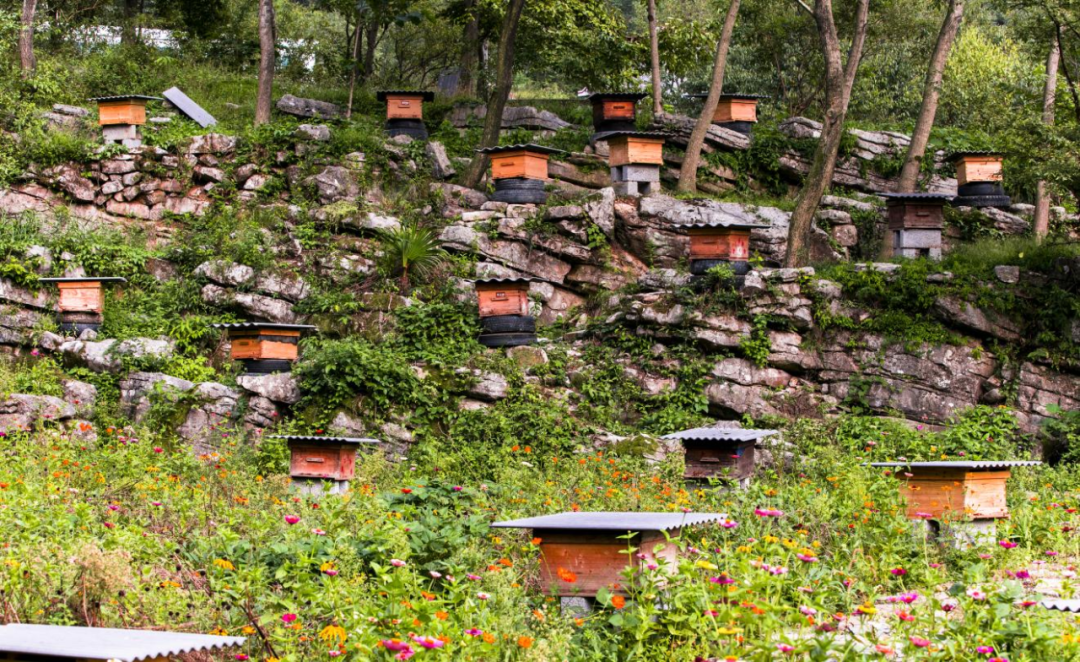 A planting base integrating forests, medicinal herbs, and beekeeping in Wufeng.
In Xiabaoping Town, Yiling District, tianma has become a local "golden crop."
"One mu yields 2,500 kilograms of fresh tianma," said Zhang Xiangdong, head of the Zhuangyuan Tianma Cooperative. "This year, I earned 800,000 yuan from seeds alone, plus more than 200,000 yuan from finished products."
Nearly 80 percent of local farmers have followed his lead.
In Ziqiu Town, Changyang, Zhang Jie has developed a successful free-range poultry business known for its “Ziqui flying chickens.” He created a model that provides farmers with chicks, disease-control services, rearing methods, and guaranteed purchasing and sales channels.
His company now maintains 400,000 native chickens and sells 31 million eggs annually. The model, recognized by the National Forestry and Grassland Administration as a national example, has helped 4,756 rural households increase their annual income by more than 10,000 yuan each.
Forest tourism is also gaining momentum. Taipingding Forest Resort Hotel in Yuan'an County welcomed 315 visitors last weekend, filling 45 rooms. Since eliminating admission fees in July 2024, its popularity has surged.
"Instead of relying on ticket sales, we prefer to attract visitors and create broader opportunities," said Chen Kang, the hotel's manager.
Yichang has cultivated more than 1,200 under-forest businesses operating on 1.085 million mu of forest land.
His company now maintains 400,000 native chickens and sells 31 million eggs annually. The model, recognized by the National Forestry and Grassland Administration as a national example, has helped 4,756 rural households increase their annual income by more than 10,000 yuan each.
Forest tourism is also gaining momentum. Taipingding Forest Resort Hotel in Yuan'an County welcomed 315 visitors last weekend, filling 45 rooms. Since eliminating admission fees in July 2024, its popularity has surged.
"Instead of relying on ticket sales, we prefer to attract visitors and create broader opportunities," said Chen Kang, the hotel's manager.
Yichang has cultivated more than 1,200 under-forest businesses operating on 1.085 million mu of forest land.
Song Yujie, Wan Chunfeng, Zeng Xuebin, Dong Zhilie, Tan Qiangming, Bian Jianxin and Fu Jiangshan contributed to this story.