Niuzhaping turns ecological gains into rural prosperity
2026-08-21 21:08:35
By Gao Qing
A distinctive local call rang out across Xiling Gorge on August 20 as several macaques descended from the cliffs onto a riverside viewing platform. Villager Yan Chengjun broke bananas into pieces for the animals, which quickly took the food and began eating. Scenes like this now unfold every day in Niuzhaping Village in Dianjun District, Yichang.
Five groups of more than 200 macaques now inhabit the southern bank of Xiling Gorge. Their return after disappearing from the area is a sign of the village's ecological recovery.
Located near the Gezhouba Dam and known locally as the "First Village at the Dam Head," Niuzhaping once struggled with water shortages, poor roads, rocky terrain, and a lack of viable industries. In recent years, the village has moved from individual environmental improvements to more systematic upgrades while developing new industries around its natural resources.
Shortly after the start of autumn, local restaurants were bustling with visitors. "When we first came here, there seemed to be only one coffee shop in the village. Now there are seven or eight, each with its own style and character," said Tang Longhan, manager of Chuxiaotian, a local rural restaurant. "With so many different businesses in one village, visitors can experience a variety of activities in a single day."
A distinctive local call rang out across Xiling Gorge on August 20 as several macaques descended from the cliffs onto a riverside viewing platform. Villager Yan Chengjun broke bananas into pieces for the animals, which quickly took the food and began eating. Scenes like this now unfold every day in Niuzhaping Village in Dianjun District, Yichang.
Five groups of more than 200 macaques now inhabit the southern bank of Xiling Gorge. Their return after disappearing from the area is a sign of the village's ecological recovery.
Located near the Gezhouba Dam and known locally as the "First Village at the Dam Head," Niuzhaping once struggled with water shortages, poor roads, rocky terrain, and a lack of viable industries. In recent years, the village has moved from individual environmental improvements to more systematic upgrades while developing new industries around its natural resources.
Shortly after the start of autumn, local restaurants were bustling with visitors. "When we first came here, there seemed to be only one coffee shop in the village. Now there are seven or eight, each with its own style and character," said Tang Longhan, manager of Chuxiaotian, a local rural restaurant. "With so many different businesses in one village, visitors can experience a variety of activities in a single day."
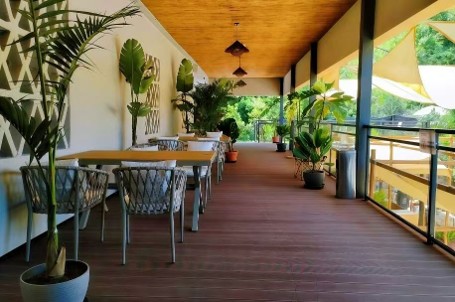
Outdoor dining area of a local rural restaurant in Niuzhaping. Photo courtesy of Dianjun District Media Center.
The growing number of visitors follows years of environmental improvements.
Positioned as a destination for short getaways, Niuzhaping has worked to turn environmental cleanup efforts into long-term improvements. Bare ground around the village's flower and nursery stock market has been covered with greenery, while climbing plants have been introduced to restore vegetation on quarry cliffs left from the construction of the Gezhouba project.
Liu Cao, deputy secretary of the village Party branch, said the village plans to build cliffside waterfalls and coffee shops to further expand its tourism offerings.
The village has also built two entrances featuring cattle-themed landmarks and renovated a 6-kilometer circular main road. More than 100,000 square meters of land has been newly greened, while ecological parking areas, pedestrian paths, and public gardens have become attractions themselves.
Nighttime businesses have also been introduced, extending commercial activity into the evening.
"Only when the village's overall environment improves can individual businesses achieve stable, long-term growth," said a local business operator.
The improvements have helped attract more businesses to the area. The 320-mu (about 21.3-hectare) Yichang flower and nursery stock market now has more than 80 merchants from eight provinces and regions, generating nearly 200 million yuan (about US$29.33 million) in annual revenue. It has also created jobs for 112 local villagers and increased the village's collective income by more than 800,000 yuan a year.
From selling products to selling experiences
Niuzhaping is now moving beyond selling products to offering scenery and experiences.
Cliffside coffee shops, restaurants converted from farmhouses, bakeries, and craft workshops have opened across the village. Niuzhaping is now home to 252 rural businesses and nearly 80 homestays and restaurants. More than 10 generate annual revenue exceeding 1 million yuan, while the village receives more than 600,000 tourist visits a year.
Once home to abandoned quarries, Niuzhaping has been transformed into a nationally recognized Beautiful Leisure Village. Through a market-oriented model involving local residents, the village has put idle ponds, disused factories, and vacant houses back into use, turning its environmental improvements into economic opportunities.
Today, Niuzhaping has developed into a regional flower and nursery stock distribution center serving western Hubei and eastern Chongqing. Its combination of environmental protection and economic development offers an example of rural revitalization in the Three Gorges area.
Pi Yajie and Hu Weilong also contributed to this story.