Qingjiang Sturgeon Valley boosts caviar capacity fivefold to reach 600 tons by 2028
By Zhou Chunyi
Qingjiang Sturgeon Valley aims to raise its annual caviar production capacity from 120 tons to 600 tons by 2028 as part of its 10-billion-yuan (US$1.48 billion) development plan.
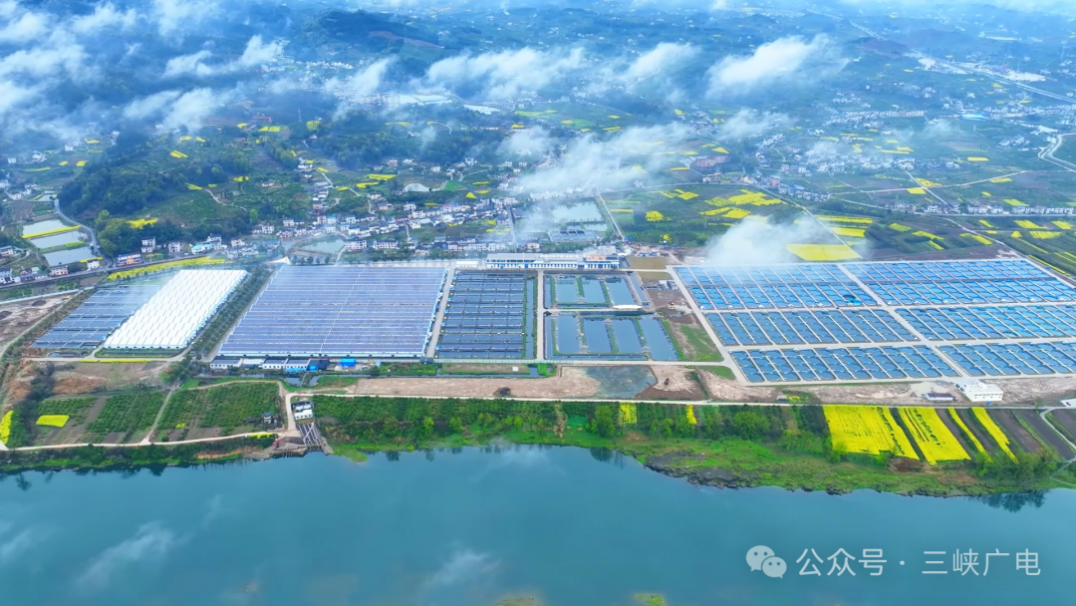
Hubei Qingjiang Sturgeon Valley.
On September 17, a delegation of journalists visited Qingjiang Sturgeon Valley, where founder and general manager Ji Jianyi introduced the development of the region's sturgeon industry.
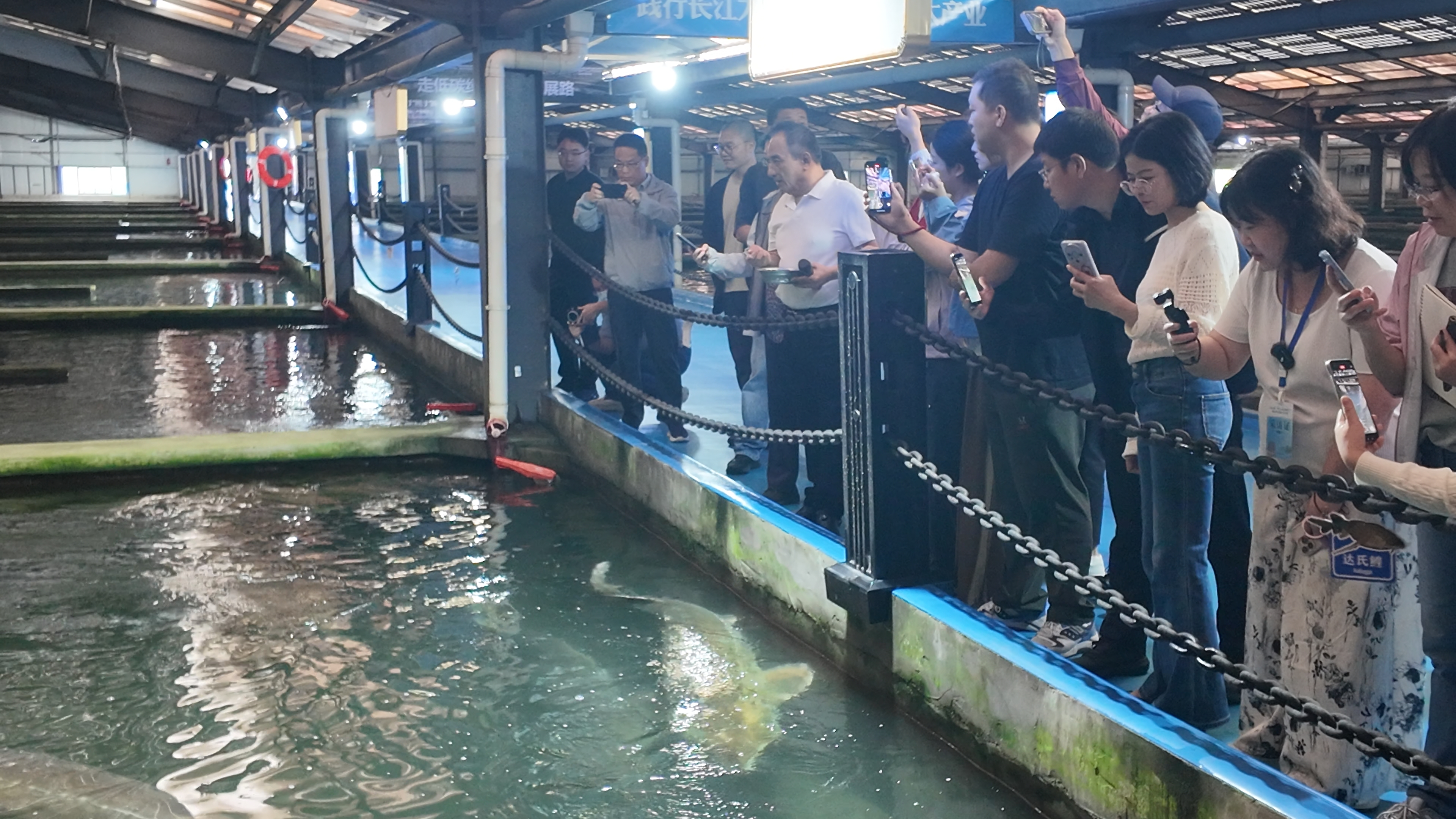
Journalists tour the onshore farming base at Qingjiang Sturgeon Valley. Photo by Sun Yumin.
A decade ago, the Gaobazhou section of the Qingjiang River was densely covered with fish cages, and sturgeon farming was a major local industry. The cages also contributed to pollution, with water quality at some monitoring points falling into the lowest category.
In 2017, Yidu ordered all fish farmers to end cage aquaculture on the Qingjiang River and encouraged them to shift to onshore sturgeon farming.
Qingjiang Sturgeon Valley was founded during this transition. To accommodate sturgeon moved ashore, the company built a 400,000-cubic-meter onshore farming base capable of holding about 8,000 tons of sturgeon. A new caviar processing center of over 8,000 square meters was built in 2025, with a theoretical annual processing capacity of 600 tons.
At the farming base, standardized tanks are arranged in rows, with some sturgeon exceeding 2 meters in length. A smart fisheries system displays real-time data on water temperature, dissolved oxygen, and feeding, while a recirculating water system operates continuously.
The company holds more than 40 invention patents. The Ministry of Agriculture and Rural Affairs and the Ministry of Finance have jointly established two workstation programs at the company where researchers study sturgeon preservation, storage, transportation, nutrition, and feed development.
With over 10,000 purebred broodstock from different species, the company can hatch more than 50 million sturgeon fry annually. It also manages a 5,000-square-meter EU-standard processing plant in Yidu, leases a 100,000-cubic-meter hatchery in Jingzhou, and operates a "company + base + standard + farmer" model in multiple areas. Together, participating farming bases have a total capacity of about 200,000 cubic meters and hold about 2,000 tons of sturgeon.
Qingjiang Sturgeon Valley has completed over 1.5 billion yuan in fixed asset and biological asset investment, with biological asset reserves exceeding 10,000 tons. According to the company, it has the world’s largest reserves of purebred European sturgeon and Kaluga sturgeon and can currently produce 120 tons of caviar annually.
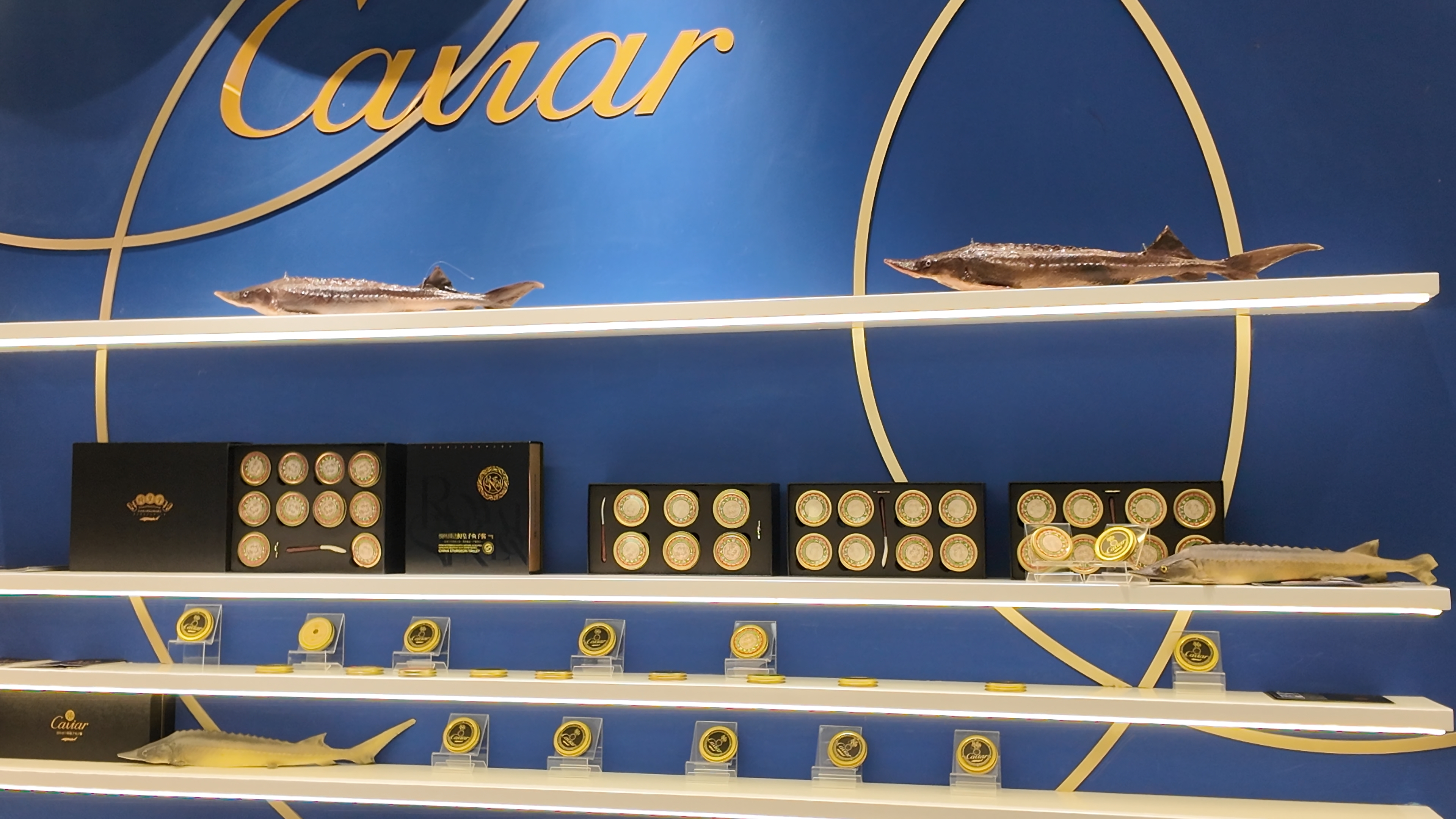
A caviar display featuring product packaging and sturgeon models. Photo by Sun Yumin.
Ji said that by the end of 2028, the valley's total biological asset reserves are expected to reach 30,000 tons, including those from affiliated farmers, with annual caviar capacity reaching 600 tons, prepared sturgeon dishes reaching 10,000 tons, and commercial fish exceeding 1,000 tons. The site is expected to receive at least 1 million tourist visits annually.
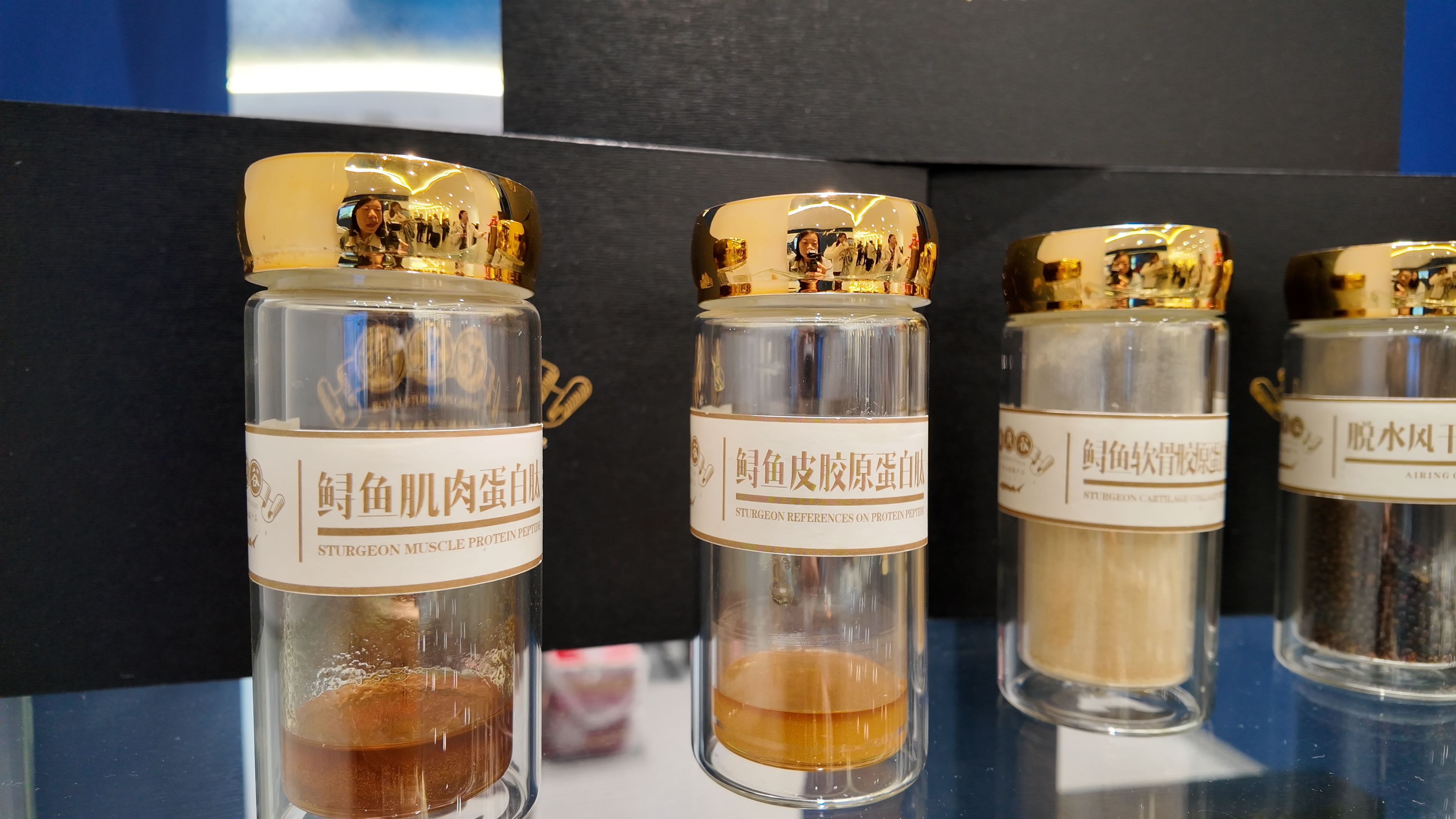
Bottles of sturgeon-derived peptide products on display. Photo by Sun Yumin.
By then, Qingjiang Sturgeon Valley aims to form a 10-billion-yuan industry chain, benefiting more than 1,500 farming households, providing over 2,000 jobs and more than 10,000 indirect jobs.
Fang Yonghua and Sun Yumin also contribute to this story.