New energy ships account for three-quarters of shipbuilding orders
2026-11-04 19:11:55
By Yan Wanqin
Technological innovation is driving Yichang's shipbuilding industry toward green and smarter production, with new energy vessels now accounting for three-quarters of the city's shipbuilding orders.
In the first 10 months of this year, Yichang's shipbuilders held orders for 232 vessels, of which 174 were new energy ships. A total of 95 vessels were delivered, including 79 new energy ones.
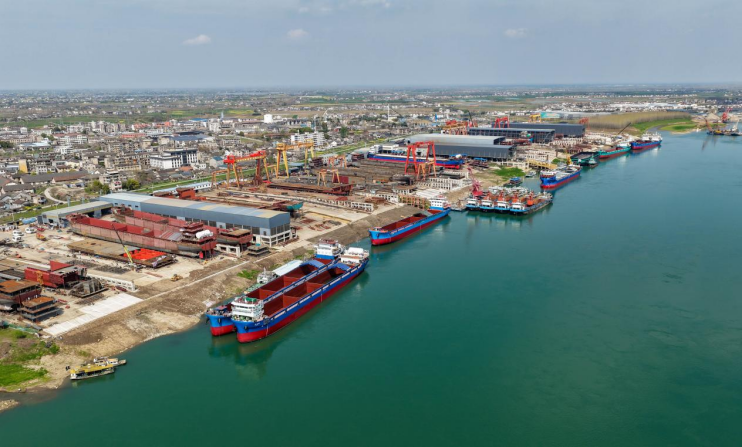 Yichang Shipbuilding Industrial Park in Zhijiang. Photo by Fu Beibei.
At Damen Yichang Shipyard, robots, rather than welders, now dominate the busiest sections of the production line. The company has introduced industrial robots and built a digital shipbuilding platform, increasing overall production capacity to more than 1.5 times that of its old plant. Laser cutting has replaced traditional flame cutting, increasing processing efficiency two- to threefold.
The company's CF3850 and CF5000 multipurpose cargo ships sell well in European markets.
The CF3850 comes in a green configuration that can carry containerized battery packs and use shore power systems to meet zero-emission requirements at EU ports. This variant is also equipped with a wind-assisted propulsion system and Damen's self-developed Triton system for remote monitoring of energy consumption.
The 50th CF3850 has been launched and will be delivered to a Maltese client this year.
"We plan to deliver 14 vessels this year, all for export. We currently have 17 vessels in hand, with production scheduled through 2028," said Wu Yinzi, general manager consultant of Damen Yichang Shipyard.
The shift is not limited to ocean-going vessels. Pure-electric sightseeing vessels for inland waterways are also rolling off production lines. Jiangbo Shipbuilding in Zhijiang has independently developed a pure-electric tourist boat with an eight-hour battery life and an autonomous navigation system capable of avoiding obstacles.
The company is shifting from traditional bulk carrier construction to tourism vessels. It has 16 orders in hand, including 11 sightseeing boats, and has delivered six new energy sightseeing vessels and cargo ships this year. More than 300 of its autonomous cruise boats are now operating at 36 scenic areas under contract with the company.
The company has established a ship design company and an R&D team this year to move beyond contract manufacturing and build its own yacht and cruise ship brand.
A similar transformation is underway at Hubei Jianghui Marine Equipment Co., Ltd., which began shifting toward the new energy sector in 2022. Its zero-noise, zero-emission pure-electric tourist boats now operate at popular scenic spots, including Xiandao Lake, Liangzi Lake, Shennong Stream, Qingjiang Gallery, and Tianjin's Haihe River.
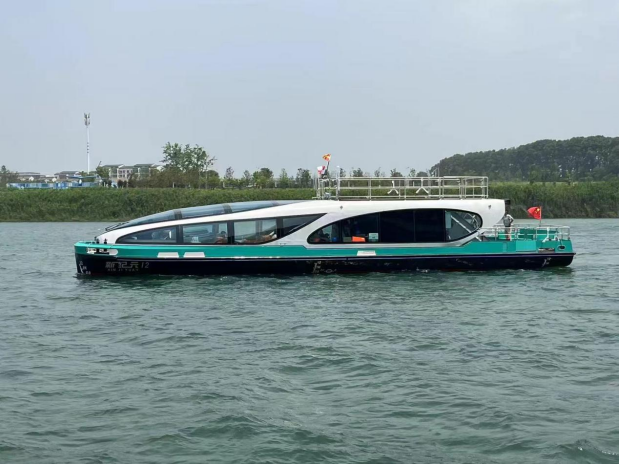
A pure-electric tourist boat built by Hubei Jianghui Marine Equipment Co., Ltd.
The shipbuilding industrial park in Zhijiang now has orders for 91 vessels, with production scheduled through 2028. In the first nine months of this year, it completed 56 vessels, with new energy ships accounting for 78.6 percent.
Yichang has developed an industrial network integrating shipbuilding parks in Yidu and Zhijiang with the Three Gorges Green Intelligent Ship Industry Technology Research Institute. The city is accelerating the integration of design, manufacturing, and supporting industries through measures such as open bidding for key technologies and flexible talent recruitment. It is also linking more than 1,300 upstream and downstream enterprises across Hubei Province.
Drawing on its 232-kilometer stretch of the Yangtze River, Yichang is promoting greener and smarter shipbuilding through improvements in production methods, vessel design, and the broader industrial ecosystem.