Scientific farming practices improve Yichang tangerine quality and yields
By Ma Yuanchen
Jinqiu Shatangju tangerines were introduced to Yichang in 2016, and the city’s planting area for this variety has reached 35,000 mu (2,333 hectares). This year, farmers are enjoying a bumper harvest of the high-value tangerines, thanks to improved varieties and the adoption of scientific farming techniques.
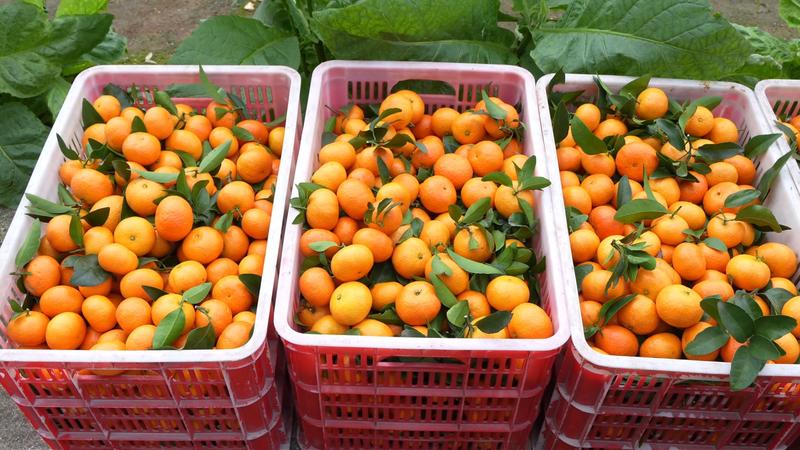
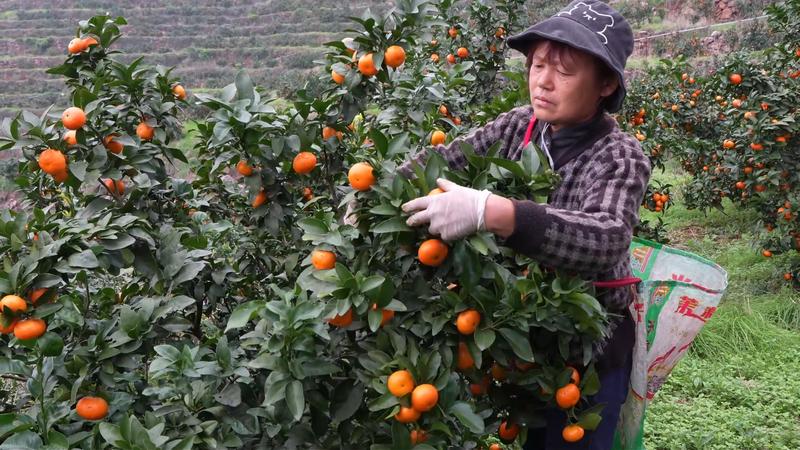
Workers pick ripe tangerines at an orchard in Yichang
Golden fruits hang heavily from trees at Huaguoyuan Orchard in Yichang. The local red sandstone soil, rich in trace minerals, creates favorable conditions for tangerine growth. The orchard’s tangerine saplings were introduced from Sichuan and produce smooth-skinned, tender, and juicy fruit. The orchard can harvest up to 2.5 tons daily, with a projected total yield of 175 tons.
Buyers from across China are flocking to the orchard, with daily orders reaching roughly 5 tons. Zhou Guimao, a buyer from Zhejiang, said this year’s fruit is of excellent quality and in strong demand. He sources 100 to 200 tons per day and has purchased thousands of tons so far.
The Changbanpo Citrus Growers Cooperative in Dangyang operates Yichang’s largest contiguous tangerine plantation. It works closely with Yichang Citrus Research Institute and Huazhong Agricultural University to roll out modern, standardized farming throughout the growing cycle.
“We used to rely on traditional experience, but now agronomists provide hands-on guidance,” said Xu Bo, head of the cooperative. From soil conditioning and formative pruning to pest management, now every stage follows scientific protocols.
This year, targeted soil improvement and precision pruning helped stabilize the fruit’s sugar content at around 15° Brix. More than 80 percent of the fruit was classified as top-grade, and output increased by 20 percent compared with last year. These improvements have brought additional income of more than 3,000 yuan per mu (US$6,706 per hectare).
Xu Junyin, senior agronomist at Yichang Citrus Research Institute, noted that integrated green farming techniques are key to improving yields and fruit quality. These include soil amendment, standardized pruning, eco-friendly pest control, and water and fertilizer integration. The high top-fruit rate of over 80 percent demonstrates the effectiveness of these measures.
Zhou Chongyu and Wang Jiao also contributed to the story.