
Innovation drives agri-growth
By Liu Kun, Zhou Jin and Wu Yong in Wuhan | China Daily
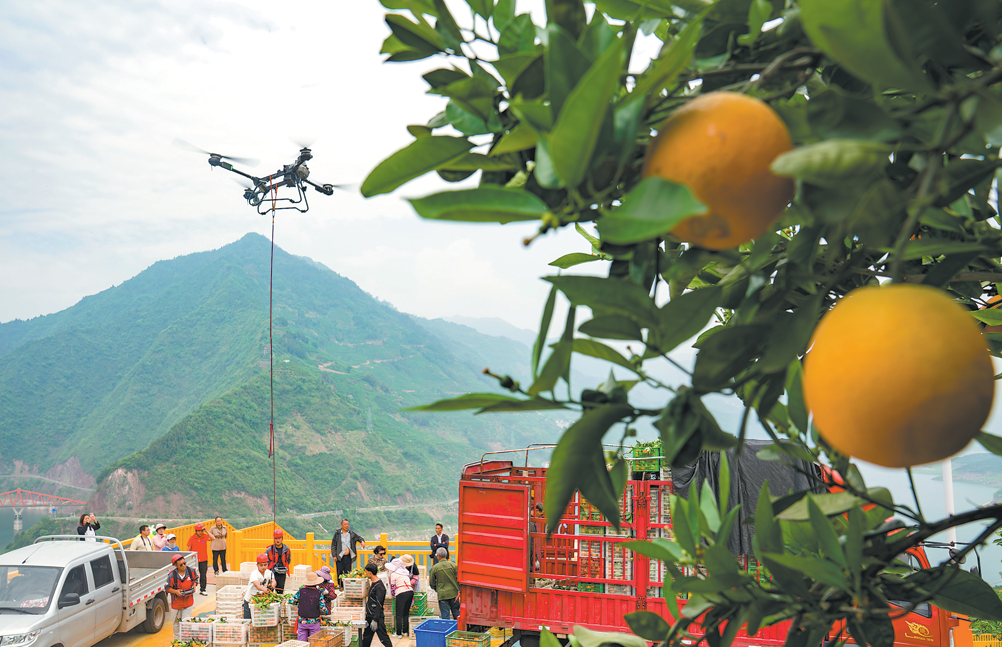
Farmers use drones to transport freshly harvested navel oranges in Pengjiapo village, Zigui county, Hubei province, on April 27, 2025. CHINA DAILY
A winter cabbage variety that reduces reliance on imported seeds, drones that carry oranges down steep hillsides and a rice mill that cuts grain breakage are tackling different problems in Hubei province's agricultural industries.
Across Hubei, research and new equipment are being connected with cultivation, processing and markets. The changes reach beyond improving harvests: they help growers overcome transport constraints, help processors reduce waste and make fuller use of raw materials, and help villages develop new sources of income.
Wang Dongmei, an official with the provincial department of science and technology, said Hubei has prioritized scientific and technological innovation in its economic, social and agricultural development.
Taking advantage of its strength in education, research and agriculture, the province is aligning agricultural research with industry needs and putting more research findings into practical use to support the development of modern agriculture, Wang said.
According to local statistics, the added value of Hubei's primary industry reached 538.07 billion yuan ($80.13 billion) in 2025, up 3.5 percent year-on-year.
Better seeds
In Jiayu county, Xianning, efforts to strengthen the cabbage industry began with the seed.
The county grows about 180,000 mu (12,000 hectares) of cabbage, producing 720,000 metric tons a year. But growers had long depended heavily on imported seeds, whose high prices and uncertain supplies made it harder to control production costs, said Qiu Zhengming, chief scientist with the Hubei Academy of Agricultural Sciences.
In 2008, Jiayu began working with a team led by Fang Zhiyuan of the Chinese Academy of Agricultural Sciences to develop varieties suited to local conditions.
After a decade of research, Zhonggan 1305, developed for winter cultivation, was introduced in 2018. It now covers nearly 100,000 mu, accounting for about 70 percent of the county's winter cabbage area.
Improvements extend beyond breeding in the county. At a vegetable science and technology demonstration park, sensors monitor temperature, humidity and pest activity. A digital platform helps standardize production from raising seedlings to harvesting, while QR codes trace vegetables to individual plots.
Technology should keep vegetables affordable for consumers while allowing growers to make a profit, Qiu said.
Ma Jiliang, a researcher at the Institute of Agricultural Economics and Development of the Chinese Academy of Agricultural Sciences, said Jiayu shows how scientific research can support local industries.
Building a regional vegetable brand with a geographical indication depends on science and technology, Ma said, adding that varieties with independent intellectual property rights are key to the industry's competitiveness.
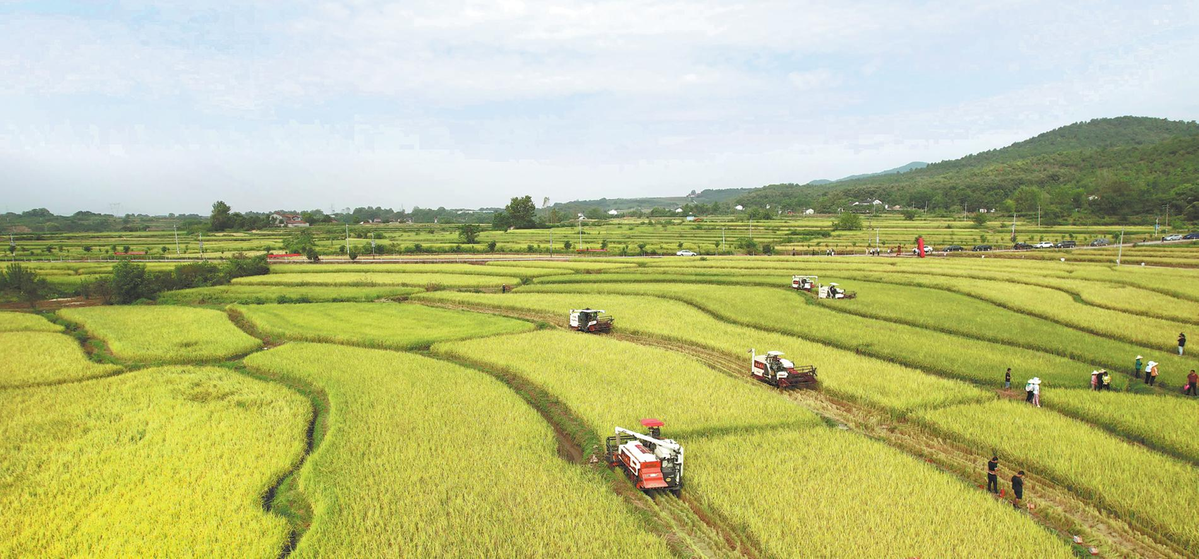
Farmers harvest Jingshan Qiaomi, a local rice specialty, in a village of Sunqiao town in Jingshan, Hubei province. CHINA DAILY
More from grain
For rice processors in Jingshan, administered by Jingmen, another opportunity lies in making better use of what has already been harvested.
Inside Hubei Guobao Qiaomi Co's plant, rice moves through husking, milling, polishing, color sorting and packaging on automated lines, monitored from a central control room.
An intelligent milling system has increased the yield of whole milled rice by about 2 percentage points.
At an annual processing volume of 300,000 tons of paddy, that improvement could yield roughly 6,000 additional tons of premium rice, worth more than 10 million yuan.
Broken rice, bran and husks can become rice flour, rice oil, protein products, animal feed and biomass fuel, extending the uses of a harvest beyond bagged rice.
Through contract farming, the company provides growers with seeds, technical guidance and common production standards before purchasing their harvest.
"We are building a whole value chain from seed breeding and standardized cultivation to deeper processing, branding and rural tourism," said Zheng Yao, deputy Party secretary of Sunqiao town, a core Qiaomi growing area.
Smarter transport
In Zigui county, Yichang, a major challenge comes after the fruit has been picked. The county produces about 1 million tons of oranges a year, but many orchards are scattered across steep mountainsides.
In 2023, the county began promoting the use of drones for transporting navel oranges on a large scale.
"It used to take about 40 minutes to carry nearly 50 kilograms of oranges down the mountain along a two-kilometer route by hand," drone pilot Guo Xingcheng said.
But with agricultural drones, it only takes one minute to transport the navel oranges from the hilltop orchard to a roadside collection point, Guo said.
Now, he said, a drone can carry about 100 kg per trip and transport about 25,000 kg in a day, which makes the work five to six times more efficient than carrying the fruit by hand.
In 2025, drones transported more than 700,000 tons of navel oranges across the county, with operations covering about 300,000 mu of orchards, said Li Li, an official with Zigui's Agriculture and Rural Affairs Bureau.
The county now has 1,050 agricultural drones and more than 2,600 drone pilots, Li said.
New technology has eased the workload of farmers and greatly improved transport efficiency, he added.
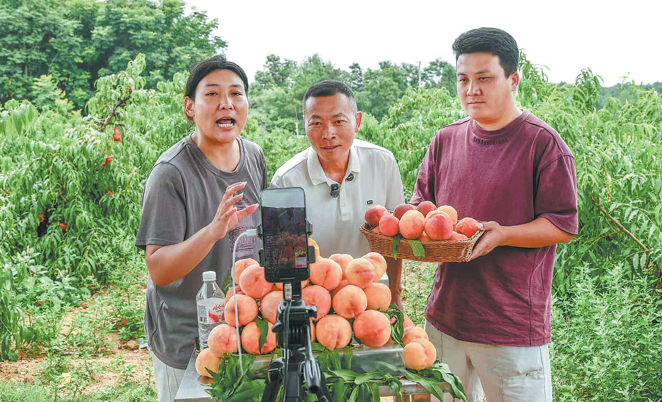
Farmers livestream from their orchards on June 17 to sell Zaoyang imperial peaches, a signature agricultural product from Zaoyang, Hubei province. LI MING/FOR CHINA DAILY
Greener aquaculture
In Ezhou, improvements in fish farming are based on a different foundation: cleaner water.
Around Sanshan Lake, local authorities began removing illegal structures and floating restaurants in 2016, extending sewage networks and treating aquaculture wastewater. After five years of restoration, the lake's water quality improved from Class IV to Class III.
Sanshan village now has about 9,800 mu of intensive fish ponds producing around 7,000 tons of freshwater fish annually. At cooperative bases, farmers can check the water temperature and dissolved oxygen level on their phones.
Wang Ge, who shifted his business focus to Sanshan in 2022, helped establish a cooperative providing fry, feed and technical guidance, and built processing facilities.
"Low-temperature, low-salt curing helps preserve the fish's fresh flavor and nutrients," Wang said.
Researchers are also improving the fish itself. The locally developed Huahai No 2 strain of Wuchang fish has been bred for faster growth.
After about a decade of research, a team led by Gao Zexia, a professor at Huazhong Agricultural University, developed a Wuchang fish strain without the fine intermuscular bones that make many freshwater fish difficult to eat.
Cold-chain links are extending the market. In one shipment, Wuchang fish reached a restaurant in Beijing, about 1,200 km away, roughly 20 hours after harvest.
Wider markets
In Dongjiao village in Zaoyang, administered by Xiangyang, premium yellow peaches can sell for as much as 20 yuan each. At a demonstration orchard, integrated irrigation and fertilizer systems, greener pest control and smart machinery help growers manage their trees.
Liu Bin, a supervisor of a local yellow-peach farming cooperative, said that in addition to testing new varieties, the cooperative is also developing and promoting rootstocks to tackle problems that arise when peach trees are repeatedly grown on the same land.
The cooperative's planting network now reaches 19 villages across 12 townships, involving more than 1,600 farming households, Liu said.
The village has nearly 1,000 mu of peach orchards, including about 200 mu under digital management, alongside cold-storage facilities.
Village livestreaming rooms help residents sell local produce to customers farther away, with training facilities allowing villagers to learn the skills needed to run their own broadcasts.
Visitors provide another market. Three households jointly converted an old residence into a restaurant, while other village properties have become cafes, bakeries and workshops.
The village sums up its approach as encouraging visitors to "stay one night, eat three meals and take two bags" of local products home. Village Party chief Hu Aiguo said per capita income reached 30,123 yuan in 2025.
From orchard work and online sales to restaurants and guest visits, the peach industry is giving residents more ways to earn a living close to home, Hu said.