Honey brings sweet earnings to villagers
2026-05-21 20:05:20
By Yan Wanqin.
Beekeeping has become a source of income for more than 30,000 households in Yichang’s mountain villages. This year, the sector is expected to produce 5,000 tons of honey and generate more than 500 million yuan (US$73 million) in output value.
Huang Fangyou, a beekeeper in Jieling Village, Yiling District, is one of them. He raises more than 300 colonies of Chinese honeybees. “So far this year, I have sold more than 400 kilograms of honey and earned over 80,000 yuan,” he said.
Beekeeping has become a source of income for more than 30,000 households in Yichang’s mountain villages. This year, the sector is expected to produce 5,000 tons of honey and generate more than 500 million yuan (US$73 million) in output value.
Huang Fangyou, a beekeeper in Jieling Village, Yiling District, is one of them. He raises more than 300 colonies of Chinese honeybees. “So far this year, I have sold more than 400 kilograms of honey and earned over 80,000 yuan,” he said.
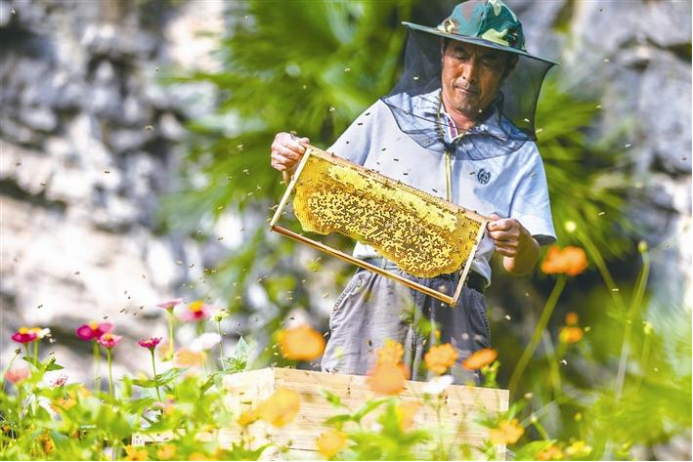 A beekeeper opens a beehive to monitor honey production progress. Photo by Yang Wei.
According to the Yichang Animal Husbandry and Veterinary Center, beekeeping has become a key driver of agricultural efficiency and rural income growth, delivering both ecological and economic benefits. Major beekeeping areas include Yiling, Wufeng, and Changyang.
Yichang is leveraging its humid climate and abundant floral resources to develop the industry. Local authorities have established beekeeping associations and technical service teams, with annual training and field visits reaching more than 80 percent of local beekeepers.
Yiling District offers rich forage for bees. The area has more than 180,000 mu (12,000 hectares) of rapeseed, 340,000 mu of citrus, and over 100 species of wild nectar plants. It has introduced a strategic development plan for the honeybee industry, built breeding centers, established six beekeeping bases, and registered more than 40 honey trademarks. Five local honey products have obtained green food certification.
Wufeng Tujia Autonomous County has pioneered a “woods + medicinal herbs + beekeeping” model. Farmers grow Chinese medicinal herbs in forested areas and keep bees nearby. The model now covers 20,000 mu and was selected as one of the 110 best cases in the Global Poverty Reduction Case Series.