
Lab turns phosphate ore into high-tech materials
2026-10-18 20:10:56
By Yan Wanqin.
A laboratory in Yichang is turning low-value phosphate ore into high-end materials worth several times more than gold. The key is a system that connects enterprise demand with laboratory research.
In the exhibition hall of the Hubei Three Gorges Laboratory jointly established by enterprises and research institutions, a seemingly ordinary "black coal ball" in a display case draws visitors’ attention.
"This is a new black phosphorus product. It sells for several thousand yuan per gram on the market, several times more expensive than gold," said Wang Liang, deputy director of the laboratory.
A laboratory in Yichang is turning low-value phosphate ore into high-end materials worth several times more than gold. The key is a system that connects enterprise demand with laboratory research.
In the exhibition hall of the Hubei Three Gorges Laboratory jointly established by enterprises and research institutions, a seemingly ordinary "black coal ball" in a display case draws visitors’ attention.
"This is a new black phosphorus product. It sells for several thousand yuan per gram on the market, several times more expensive than gold," said Wang Liang, deputy director of the laboratory.
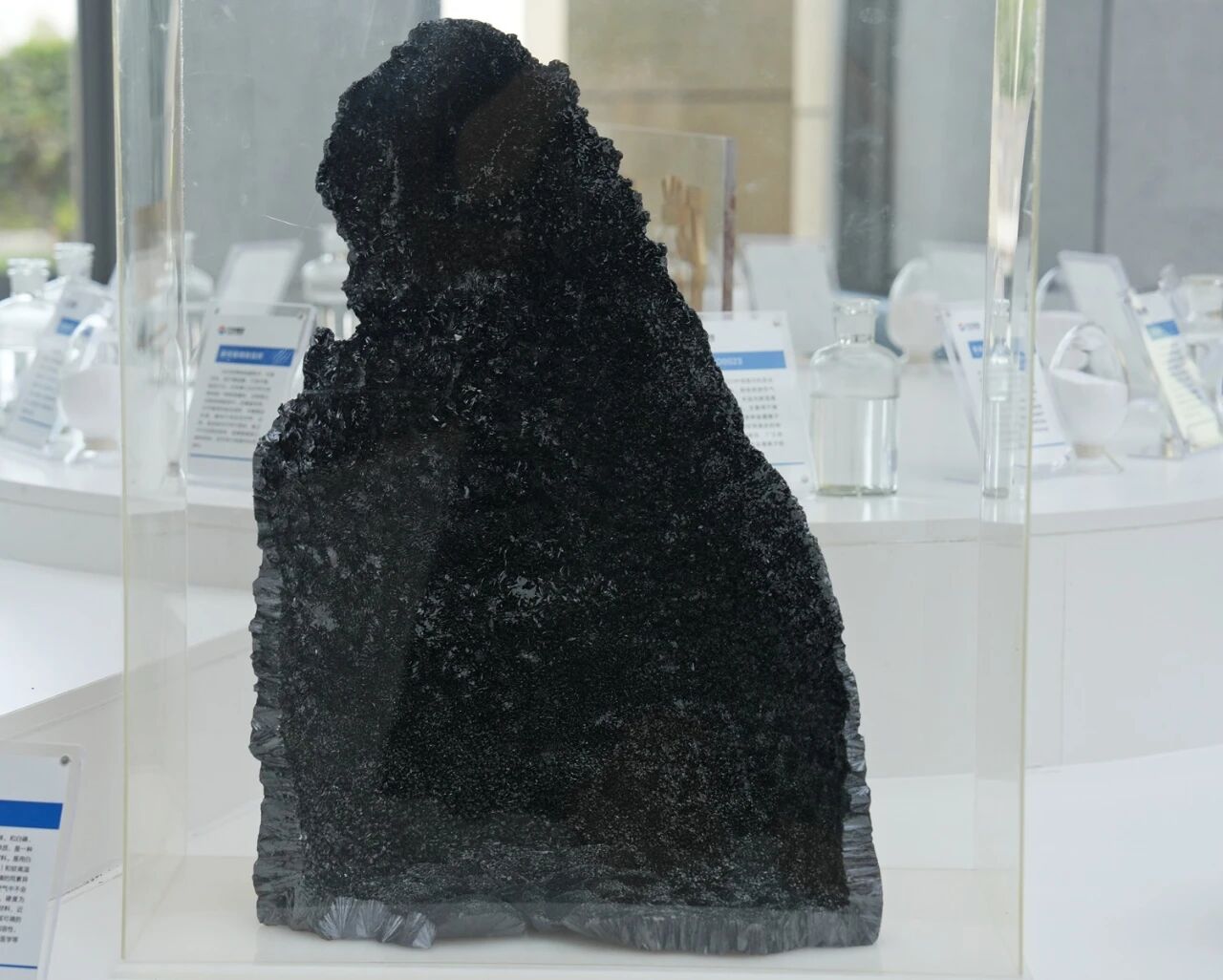
Black phosphorus samples displayed at the Hubei Three Gorges Laboratory. Photo courtesy of Hubei Three Gorges Laboratory.
It is a striking transformation: phosphate ore once sold by the ton is now being turned into cutting-edge materials sold by the gram, thanks to a system that connects laboratory research with industrial production. During the process, both parties share risks and the request initiator is the preferred buyer of the new technology.
Launched in December 2021, the Hubei Three Gorges Laboratory was jointly established by 12 institutions including Xingfa Group, the Institute of Process Engineering under the Chinese Academy of Sciences, and Wuhan Institute of Technology. It focuses on four major areas, including key chemicals for microelectronics and high-end phosphorus-based chemicals. Xingfu Group is one of Yichang’s major state-owned chemical companies.
"Once a result comes out of the lab, it can go straight onto the production line," Wang said. "That mechanism smooths the path from research to application."

The Hubei Three Gorges Laboratory. Photo by Wang Changming.
Returning to the black phosphorus sample, black phosphorus is a next-generation semiconductor material that can serve as an alternative to imported silicon and as an anode material for new energy batteries. Previously, the material had long remained at gram-level output and sold for tens of thousands of yuan per gram. The lab’s new technology can produce 100 kilograms of black phosphorus crystals per batch.
"After we mastered the key technology, we cut production costs by half," said Wang Jiannan, head of the black phosphorus R&D project.
Black phosphorus metal catalysts have also been applied in the hydrogen peroxide production process of a Xingfa Group subsidiary, increasing hydrogenation efficiency by about 20 percent.
Another example is a photoinitiator used in photoresists, a key material that affects their sensitivity and resolution and for which China had previously relied almost entirely on imports.
He Zhaobo, director of the R&D center at Hubei Sinophorus Electronic Materials, recalled that discussions with clients revealed strong market demand for the material. The project was launched at the laboratory in late 2022.
Zhou Gangxiang, who had just received his doctorate from Heidelberg University in Germany, joined a five-member research team.
"From grams to kilograms and then to tons, we went through thousands of experiments of various sizes, and no one ever gave up on the goal," Zhou said. The hardest part was stability. "Fluctuations in reaction conditions had to be kept within 0.5 percent."
In March 2025, pilot samples were sent to a leading company in Shanghai for testing. Two months later, the feedback came: all indicators were on par with imported products.
"At that moment, our joy was beyond words," Zhou said.
In December 2025, Sinophorus acquired the technology for 46.27 million yuan, making it the laboratory's first industrial project valued at over 10 million yuan. The project is still undergoing approval, with an expected annual production capacity of 30 tons, while a 300-ton facility is being planned.
From black phosphorus to photoinitiators, the Hubei Three Gorges Lab is bringing more research results into industrial production, supporting the chemical industry’s green transformation and China’s efforts to develop key materials domestically.
Zhou Chengxin contributed to this story.